Friday's Reckoning: Inside Henley's Brutal Qualifying Races
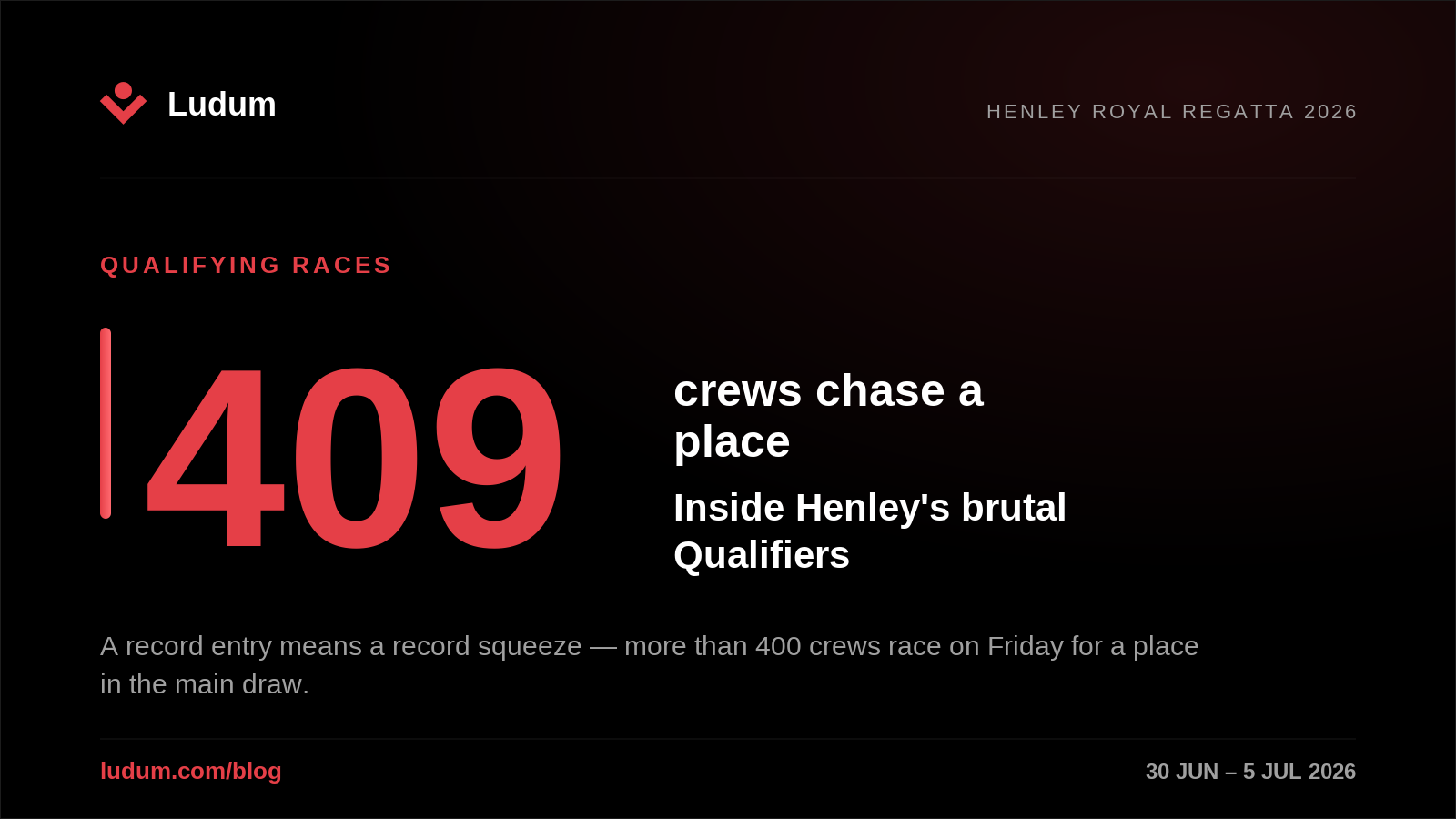
Henley Royal Regatta has a problem that most regattas would kill for: too many crews want to race it. The 2026 entry is a record 862 crews — and the course has not grown an inch. Something has to give, and on the Friday before the Regatta proper, it does.
That something is the Qualifying Races: a single timed run down the course, the week before racing begins, for every crew in an oversubscribed event. No heats, no repechage, no second attempt. The fastest qualify into the main draw. Everyone else goes home. It is, quietly, the most ruthless day in British rowing.
The maths of the squeeze
Henley caps its events. When entries exceed the cap, the surplus must qualify. In 2026 the numbers are stark:
- Around 450 crews are effectively safe in the main draw
- More than 400 crews are racing the Qualifiers for the places that remain
- For the biggest events, fewer than half the entry will survive to Tuesday
Put another way: a meaningful chunk of that record 862 will never get a proper Henley race. They will drive to Henley-on-Thames, boat once, row 2,112 metres flat out against the clock, and find out by Friday evening whether their summer continues.
The hardest event to enter
No event embodies the squeeze like the Temple Challenge Cup, the student men's eight. It is the biggest single event at Henley 2026 with 87 entries — and it reduces to just 32. Fifty-five crews, more than three for every two that make it, will be eliminated before the Regatta opens.
It is far from alone. The most oversubscribed events take brutal cuts:
- Temple Challenge Cup (M8+ student) — 87 entered, 32 race — 55 cut
- Fawley Challenge Cup (M4x junior) — 72 entered, 24 race — 48 cut
- Diamond Jubilee Challenge Cup (W4x junior) — 55 entered, 24 race — 31 cut
- Island Challenge Cup (W8+ student) — 52 entered, 24 race — 28 cut
- Wyfold Challenge Cup (M4- club) — 59 entered, 32 race — 27 cut
- Britannia Challenge Cup (M4+ club) — 42 entered, 16 race — 26 cut
The junior and student events take the heaviest losses, because that is where the entries pile up. A junior quad in the Fawley is one of 72 crews chasing 24 places. A student eight in the Island is one of 52 chasing 24. For these crews, Qualifiers isn't a formality before Henley — Qualifiers is their Henley, and most of the summer's hope rides on one timed piece.
The boom that feeds the squeeze
The pressure is rising because entries are. The Britannia Challenge Cup, for club coxed fours, is the sharpest example: it has more than doubled in a year, from 18 entries to 42 — a 133% jump, the biggest rise anywhere on the sheet. Brilliant for the health of the event; brutal for the crews, because that trophy still only takes 16 into the draw. More demand, same supply, harder qualifier.
The flip side: the elite scarcity
Not every event is a scrum. At the very top, the opposite problem applies. The Grand Challenge Cup — the men's eight, the most prestigious prize in rowing — drew just two entries. The women's Remenham the same. The elite events are so demanding that few crews in the world can credibly enter; there, the drama is quality, not quantity. Henley contains both extremes on one sheet: events nobody can get into, and events almost nobody can enter.
Margins this fine are won with data
When a place at Henley comes down to a single timed run, the winter behind it is everything. Ludum helps coaches and crews find the seconds that matter — training load, telemetry and performance trends in one platform. Explore Ludum.
Figures from the official Henley Royal Regatta List of Entries (© Henley Royal Regatta, produced by Weatherbys Ltd), as published before the Qualifying Races. Reduction targets as printed on the entry sheet. Entries, not results.